January 23, 2026
884 views
💍 Getting Married in Italy (Civil Ceremony) — Legal Rules for Foreign Non-Residents
Italy allows civil marriages anywhere in the country, including Sicily, even if neither partner is a legal resident. A civil wedding in Italy is fully legally binding under Italian law and is therefore recognised abroad once registered with the appropriate foreign authority.
Fast navigation:
General requirements | Apostille | British citizens | US citizens | Irish citizens | Russian citizens | Maltese citizens | Norwegian citizens | Greek citizens | Where to translate? | Common issues
General legal requirements
1️⃣ No official residency requirement
You don’t need to be resident in Italy to marry civilly — a valid passport is enough.
2️⃣ Key documents needed:
- Valid passports
- Birth certificates with parents names
- Evidence of divorce or death of spouse if applicable.
Please, note: under Italian law, a divorced woman must normally wait 300 days (about 10 months) from the final divorce judgment before marrying again in Italy.
- A Certificate of No Impediment (CNI) / Nulla Osta / Affidavit showing you are legally free to marry in Italy
- Translations and legalisations/apostilles where required
3️⃣ Document validity & timing:
- Civil documents must generally be issued within 6 months before the ceremony (official Italian requirement).
- If you are divorced, the decree must be final (no appeal) and incorporated with your other papers.
- In some cases, Italian town halls want documents well in advance (2-3 months, if especially peak season).
4️⃣ Marriage banns / publications:
Italy’s traditional pubblicazioni di matrimonio (banns) are not required for non-residents in all Comuni; many allow civil weddings without the 8-day publication period that applies for residents. However, many town halls will kindly ask you to arrive 1-3 days in advance and to sign these banns personally just before the ceremony.
5️⃣ Witnesses:
Two adult witnesses of any nationality (with a valid ID/passport) must attend the civil ceremony — Italian rules are strict about their presence.
📜 What Is an Apostille and Why It Matters
The Apostille is a certification stamp that authenticates foreign documents for use in Italy and other countries part of the Hague Apostille Convention (1961). Italy accepts documents apostilled in the country of issue if that country is a signatory.
👉 Example: If a U.S. birth certificate has a U.S. state apostille, Italy will accept it with correct translation and authentication.
Which countries may NOT need apostille for Italy?
Within the EU, Regulation (EU) 2016/1191 simplifies formalities for certain public documents. Italian diplomatic sources explicitly note that, under this Regulation, an apostille may not be required in specific civil-status contexts (example: apostille not required for some purposes of transcription).
The EU e-Justice portal provides the Multilingual Standard Forms that can accompany certain EU public documents (birth, marital status, etc.).
Reality check: Some Comuni still ask for apostille out of caution or because your document type doesn’t fall neatly under the Regulation. Always align with your specific town hall.
🇬🇧 British & Scottish Citizens legal requirements
📄 Certificate of No Impediment (CNI)
- Issued by your local UK Registry Office.
- Must be issued no more than 6 months before your ceremony and have a paper Apostille applied.
- You can find step-by-step procedures here: https://www.gov.uk/marriages-civil-partnerships-abroad
📍 For Scottish couples, the local Registrar issues the CNI and includes the required details (parents, etc.), similar to the rest of the UK. Certificate of No Impediment (Scotland): If resident in Scotland, you can apply for a CNI no earlier than three months before the wedding date (standard Scottish rule).
Practical tip: UK CNIs often involve a notice/publication period, so UK/Scotland couples should start early.
💡 In addition, British citizens also need a bilingual statutory declaration signed before a notary/solicitor and apostilled.
🇺🇸 American Citizens
Certificate / Declaration of No Impediment
Italy generally requires U.S. citizens to produce an official affidavit (Dichiarazione Giurata / Atto Notorio) showing you are free to marry under U.S. law. This can be issued at a U.S. Embassy or Consulate in Italy under oath or via Italian consular procedures. Many Italian Consulates in the U.S. also publish detailed lists for U.S. citizens marrying in Italy (birth certificate format, apostille, translations, divorce docs, etc.).
Birth/Divorce Documents
- U.S. long-form birth certificate (with parents’ names) is usually required to prove identity and status.
- If applicable, your divorce decree must also be apostilled and translated.
📍 Apostille & Translation Rules
- Apostille is issued by the Secretary of State of the state where the document was issued.
- Certified Italian translation with a Certificate of Accuracy is required.
🇮🇪 Irish Citizens
📄 Certificate of Freedom to Marry
Issued by the Irish Department of Foreign Affairs and confirming no marriage impediment. The Irish government provides an online service and guidance (updated April 2025).
The Embassy of Ireland in Italy also provides a dedicated page explaining the process for marriage/civil partnership paperwork.
📍 Apostille
Depending on where it’s issued, you might need an apostille (confirm with the issuing office).
🇷🇺 Russian Citizens
📄 Certificate of No Impediment
Issued by the Russian consulate in Palermo on the same day. It must state your legal capacity to marry.
You can consult the list of documents for the submission HERE
📍 Apostille
Russia is a signatory of the Apostille convention; Russian documents must be apostilled and translated into Italian before submission. In Palermo, the local Prefettura issues the apostille, which can take from one day to one week.
🇲🇹 Maltese Citizens
📄 Certificate of No Impediment
Issued by Maltese authorities confirming freedom to marry.
📍 Apostille
Maltese apostille costs are typically modest (e.g., around €12) and confirm document authenticity in Italy.
🇳🇴 Norwegian Citizens
📄 No Impediment Document
Norway’s Tax Administration (Skatteetaten) provides official guidance and forms for the certificate of no impediment process.
📍 Apostille
For document legalisation, Norway’s Ministry of Foreign Affairs notes that legalisation by the Ministry is free of charge.
For the apostille/legalisation of Norwegian documents, the County Governor (Statsforvalteren) provides guidance on the use of apostilles for documents intended for use abroad here.
🇬🇷 Greek Citizens

📄 Certificate of No Impediment
Issued by Greek consular authorities or Greek civil status offices.
📍 Apostille
EU advantage: As an EU citizen, you may be able to use the EU public documents regime to avoid apostille in specific cases (see Section 6). Even as an EU citizen, confirm whether your local EU multilingual format can be used (often still easier with apostille and translation).
Translations: do them in your home country or in Italy?
Option A — Translation abroad (home country)
Pros:
- Often faster if you already have a trusted sworn/certified translator
- Convenient before travel
Cons:
- Some Comuni prefer or require an Italian “sworn” translation model or a translation that meets Italian court/consular standards (this is especially common with U.S. documents, where some Italian consulates specify translation requirements)
Option B — Translation in Italy (sworn / “asseverata”)
In Italy, sworn translations often involve the Tribunale and stamp duty (“marca da bollo”) rules. For example, Italian court guidance (Tribunale di Bologna) explains the stamp duty logic (e.g., €16 marca da bollo per a defined number of pages/lines).
Common pitfalls (and how to avoid them) during your legal paperwork for getting married in Italy (Sicily)
1. Documents issued “too early”
Some countries’ no-impediment documents have practical validity windows; some registrar systems also restrict how early you can apply (e.g., Scotland guidance: no earlier than 3 months). Follow your wedding planner’s advice regarding the town hall requirements on the document submissions (some can accept docs just a few days before the wedding, some not)
2. Wrong birth certificate format
Some authorities request “long form” birth certificates (notably in U.S. consular guidance for marrying in Italy). Be sure to double-check the format with your wedding planner and/or the town hall before the apostille issue and translation.
3. Missing apostille on the correct item
Apostille applies to the public document (and sometimes to notarised translations, depending on where they were produced and how the Comune treats them). When in doubt: apostille the original public act, and keep the translation pathway aligned with Comune instructions.
4. Consulate appointment delays
Especially for U.S. affidavits in Italy, you should also book the Russian Consulate in Italy in advance for Nulla Osta issue. Contact your wedding planner and/or start the planning in advance – at least 2-3 months before the wedding date is the minimum requirement.
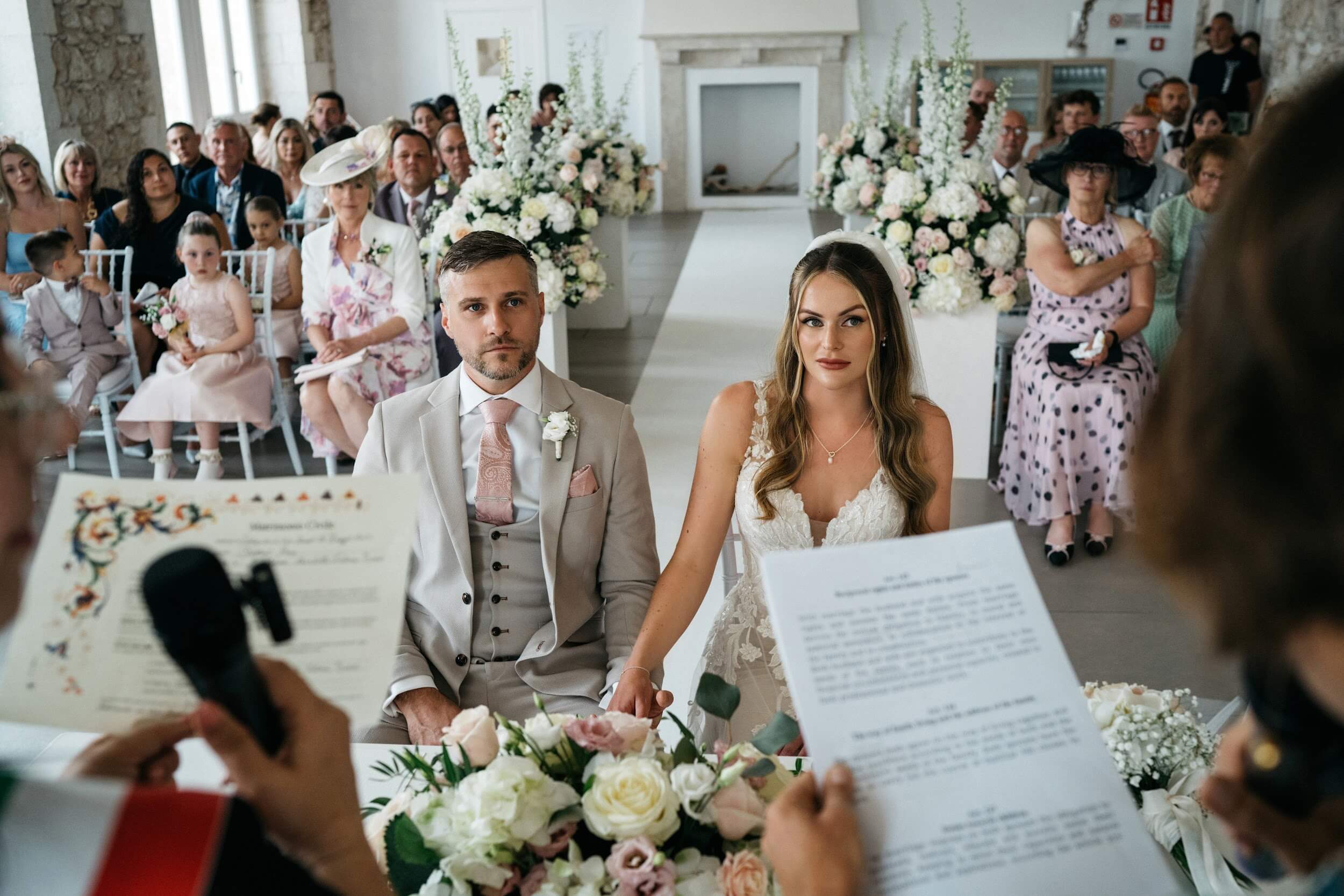
If you plan a legal wedding in Sicily, you are in the right place, we have experience in providing legal paperwork assistance within full and partial wedding planning services, you can check this real wedding from the portfolio, as an example. You can request a first complimentary consultation regarding your case here